USCIS Prior Approval Deference Removal: What Changes for H-1B and Other Work Visas

USCIS Prior Approval Deference Removal: What Changes for H-1B and Other Work Visas?
DHS proposes a major change to how previous USCIS immigration approvals are considered in future employment-based petitions.
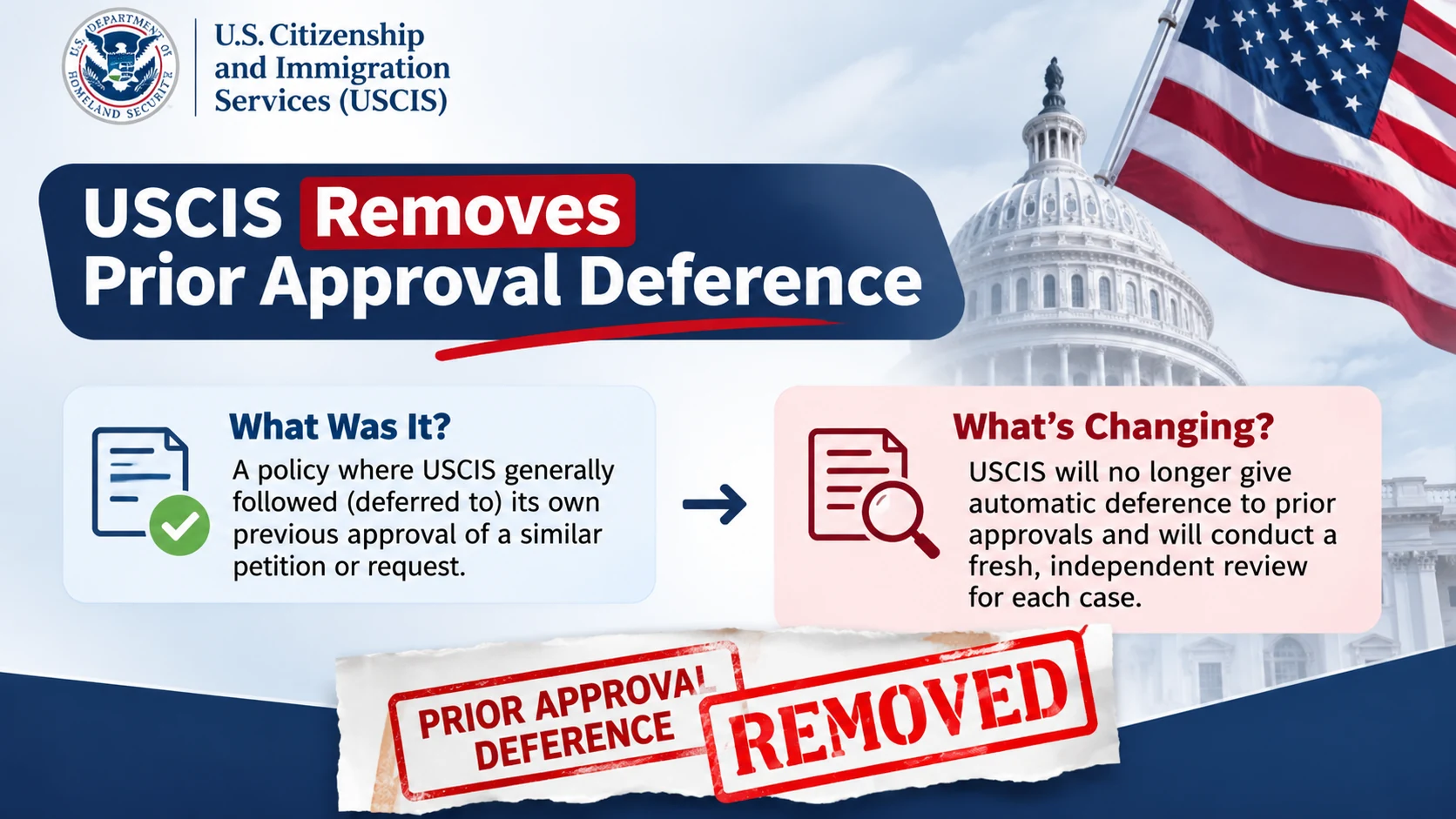
The proposal has not become a final regulation as of November 16, 2026.
Quick Overview: USCIS Prior Approval Deference Removal is a proposed DHS rule that would end the regulatory requirement for officers to generally defer to certain earlier eligibility decisions when reviewing qualifying Form I-129 petitions. If finalized, the change could affect how employers prepare H-1B, L-1, O-1 and other covered nonimmigrant worker extensions. It does not automatically cancel existing visa approvals.
What Is USCIS Prior Approval Deference Removal?
USCIS Prior Approval Deference Removal refers to a proposed change in the way US immigration officers evaluate certain repeat employment-based petitions. The issue concerns the importance given to an earlier USCIS approval when an employer submits another petition for the same worker under substantially unchanged circumstances.
Under the existing regulation, USCIS generally gives deference to a qualifying earlier eligibility determination when the same petitioner, beneficiary and underlying facts are involved. This is known as prior approval deference.
Consider a technology company that has already received approval for an H-1B employee. When the company later requests an extension under the same classification, the earlier decision generally receives consideration if the relevant circumstances have not materially changed.
That approach does not guarantee approval. Employers must still establish eligibility and satisfy the requirements applicable to the new petition.
DHS now proposes removing the regulatory requirement that officers generally defer to these previous decisions. The proposed change would allow USCIS to evaluate each covered petition independently.
What Did DHS Announce on October 14, 2026?
The Department of Homeland Security published a Notice of Proposed Rulemaking titled "Removing Deference to Prior USCIS Determinations of Eligibility" on October 14, 2026.
The proposal targets 8 CFR 214.1(c)(5), the regulation that addresses deference to certain prior eligibility determinations involving nonimmigrant worker petitions.
| Policy Information | Details |
|---|---|
| Agency | Department of Homeland Security |
| Immigration Service | USCIS |
| Publication | October 14, 2026 |
| Federal Register | 91 FR 65119 |
| Document Number | 2026-20941 |
| Docket ID | USCIS-2026-0529 |
| Regulation | 8 CFR 214.1(c)(5) |
| Comment Deadline | November 13, 2026 |
| Current Status | Proposed, not finalized |
The central question is whether an earlier approval should continue to receive mandatory regulatory deference when USCIS examines a subsequent petition. DHS wants to remove that requirement and give adjudicators more flexibility to assess current evidence.
How Does the Existing Deference Policy Work?
Prior approval deference is intended to support consistency in immigration adjudications. It recognizes that USCIS may already have examined a worker's eligibility in an earlier proceeding.
For example, an employer obtains an H-1B approval for a software professional. Later, the same employer submits a qualifying extension request for that employee. If the petitioner, beneficiary and underlying facts remain the same, USCIS generally gives weight to the earlier eligibility decision.
There are important exceptions. Officers may revisit an earlier determination when there was a material error, a significant change in circumstances or eligibility requirements, or new material information that adversely affects eligibility.
What Could Change Under the New USCIS Proposal?
If DHS finalizes the proposal, an officer would not be required to begin a qualifying review by deferring to the earlier decision.
Instead, USCIS could examine the new filing independently and determine whether the evidence establishes eligibility under the applicable classification.
| Existing Approach | Proposed Approach |
|---|---|
| Generally gives deference to qualifying previous decisions. | No mandatory regulatory deference. |
| Previous approval receives weight when facts remain unchanged. | Earlier approval may still be considered, but need not receive deference. |
| Material errors and changes can justify a new review. | Independent review could be conducted without that deference requirement. |
| Previous decisions provide a degree of continuity. | Current evidence becomes central to each adjudication. |
Potential consequences include more detailed evidence reviews, additional questions about employment arrangements and greater preparation requirements for employers. However, the proposal does not guarantee more RFEs or longer processing times in every case.
Which Work Visa Categories Could Be Affected?
The proposal concerns covered benefit requests filed using Form I-129, Petition for a Nonimmigrant Worker. Its potential scope extends beyond H-1B petitions.
The actual impact depends on the specific petition and final regulatory language. The proposal should not be interpreted as changing every immigration application or every dependent's filing process.
What Does This Mean for H-1B Visa Holders?
H-1B workers may pay close attention to this proposal because employers regularly file extension petitions to continue an employee's authorized work in the United States.
Under the existing approach, qualifying extensions can benefit from the earlier eligibility determination. If the proposed requirement is removed, the employer may need to demonstrate continued eligibility through a fresh and well-supported filing.
Useful records to organize include:
- Current job duties and position details.
- Employment agreement and employer-employee relationship evidence.
- Wage details and relevant Labor Condition Application records.
- Worksite and employment-condition information.
- Immigration status and I-94 records.
- Previous Form I-129 petitions and approval notices.
Why Does DHS Want to Remove Prior Approval Deference?
DHS argues that mandatory deference can restrict an officer's ability to independently evaluate a new petition when the earlier approval is no longer an adequate basis for determining current eligibility.
The department also emphasizes that the petitioner has the responsibility to demonstrate that the requested immigration benefit is available under the law.
Its stated objectives include strengthening individual case reviews, identifying inconsistencies, evaluating current evidence and reinforcing the petitioner's burden of proof.
These are the department's policy arguments. They do not establish that every previous USCIS approval was incorrect or that all employers have failed to meet immigration requirements.
USCIS Prior Approval Deference Policy: Important Timeline
USCIS introduced guidance generally supporting deference to qualifying previous approvals.
USCIS rescinded the earlier deference guidance.
USCIS reinstated the policy through its Policy Manual.
DHS codified the provision in 8 CFR 214.1(c)(5) through the H-1B Modernization Final Rule.
DHS published its proposal to remove the regulatory deference requirement.
The published deadline for public comments passed.
Current Status: Is Prior Approval Deference Already Removed?
No. As of November 16, 2026, the DHS proposal has not become a final regulation.
The public comment deadline of November 13, 2026 has passed, but that does not mean the proposed regulation automatically took effect. DHS must complete the applicable rulemaking process and publish any final rule with its effective date.
- Keep copies of previous I-129 petitions and approval notices.
- Maintain accurate employment and wage documentation.
- Review job descriptions and worksite details.
- Keep immigration status records organized.
- Monitor the official rulemaking docket for new announcements.
- Consult an immigration attorney before making individual case decisions.
Official Sources and Government Links
Verify the Policy From Official Sources
📄 Federal Register — Full Proposed Rule 🔎 DHS Rulemaking Docket 🌐 USCIS Official Website 📋 Form I-129 DetailsFrequently Asked Questions
1. What is USCIS Prior Approval Deference Removal?
It is a proposed regulatory change that would eliminate mandatory deference to certain earlier USCIS eligibility decisions in covered subsequent petitions.
2. Has the deference policy officially ended?
No. The October 14, 2026 publication is a proposed rule, not a final regulation.
3. Does the proposal include H-1B extensions?
Yes. Covered H-1B extension petitions filed using Form I-129 fall within its potential scope.
4. What is 8 CFR 214.1(c)(5)?
It is the regulatory provision that establishes deference to certain previous USCIS eligibility determinations.
5. Will USCIS completely ignore previous approvals?
No. Officers may still consider earlier approvals, but would no longer be required to give them regulatory deference.
6. Can this change lead to more RFEs?
It could lead to more detailed reviews and additional evidence requests in some cases, but an RFE is not automatic.
7. Will existing H-1B visas be cancelled?
No. The proposal does not automatically revoke existing approvals or cancel employment authorization.
8. When did public comments close?
The published deadline was November 13, 2026.
9. How can employers prepare?
Employers can organize job descriptions, wage records, employment documentation and previous approval notices.
10. Where can I check the latest rule status?
Check the Federal Register and Regulations.gov docket USCIS-2026-0529 for official updates.

Result For India News Desk
Verified updates on education, exam dates, government schemes, and public notifications.